
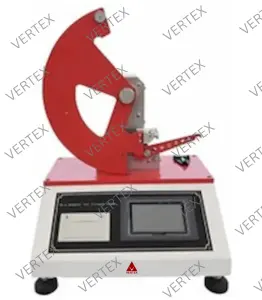
Digital Tear Tester
The Digital Tear Tester is a versatile and high-precision instrument specifically engineered for measuring the tear strength of various materials, including paper, films, textiles, leather, and sheet composite materials. It serves as a critical measuring tool for industries such as paper production plants, packaging enterprises, chemical industries, and quality inspection departments. By providing accurate digital readouts of the force required to tear rubber sheets, plastics, and other composites, it ensures precise quality control. Furthermore, its durable build is designed for long-term use in demanding industrial environments, with a dedicated focus on providing repeatable and reliable data collection for every test.
Product Overview
The Digital Tear Tester is a high-precision testing instrument designed to determine the average force required to propagate a single-rip tongue-type tear starting from a cut in paper, cardboard, and textiles. It is an essential tool for evaluating the tear resistance of various materials, ensuring they meet the durability requirements for real-world applications.
Technical Specifications
| Parameters | Specification |
|---|---|
| Measuring Range | 10-16000mN s |
| Division | 0.1mN |
| Indication error | ±1% |
| Indication variability | ≤1% |
| Tear arm | 104 ±1mm |
| Tear initial angle | 27.5 ±0.5° |
| Paper clamp distance | 2.8 ±0.3mm |
| Sample cut length | 20 ±0.5mm |
| Data display | LCD display |
| Print output | Modular integrated thermal printer |
| Dimensions | 410*320*600mm |
| Environmental conditions | Indoor temperature (20±10)℃ |
| Relative humidity | < 85% |
| Power supply | 220V, 50Hz |
Advanced Features
Digital Micro-Processor Control
Equipped with an advanced microprocessor-based controller that ensures high-precision measurement accuracy. The system provides direct digital readouts on a bright display, eliminating manual calculation errors.
Precision Pendulum Mechanism
Utilizes a low-friction pendulum system based on the Elmendorf principle. This allows for the accurate measurement of tearing force across a wide range of materials, from thin films to heavy cardboard.
Integrated Safety Protection
Includes built-in protection for the hardware and sensors. The robust design features a stable base to minimize vibrations, ensuring that the test results are not affected by external movements.
Comprehensive Data Analysis
Features integrated data logging and analytical capabilities. It allows quality control teams to benchmark manufacturing quality by comparing tear resistance data across different production batches.